Taewoo Park

PhEVRA

AI has made it cheap to generate a scientific claim. Establishing that it holds in a physical system still takes a scientist, an instrument and time.

What our customers could actually feel

We stopped OPTIMETA after its first version. Running Trendchaser for more than 600 members, I watched capabilities that once sustained whole SaaS businesses become features of general-purpose models. Talking to our customers brought that collapse home. We had made a substantial technical advance. A student sitting down to study could barely feel it.

We chose a problem further out, one that another release could never make redundant. In my lab, a model can propose a hundred results by morning. Someone still has to establish which ones are true.
PhEVRA begins with a question from the bench

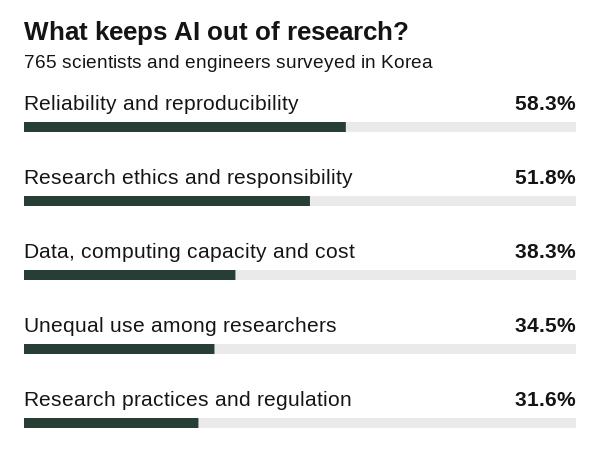
In experimental physics, an answer has consequences. Someone reserves the microscope, prepares the sample and measures it again. In a spring 2026 survey of 765 scientists and engineers in Korea, 96.7% reported using AI. Asked what made it difficult to use in research, 58.3% cited reliability and reproducibility, the most frequent answer.

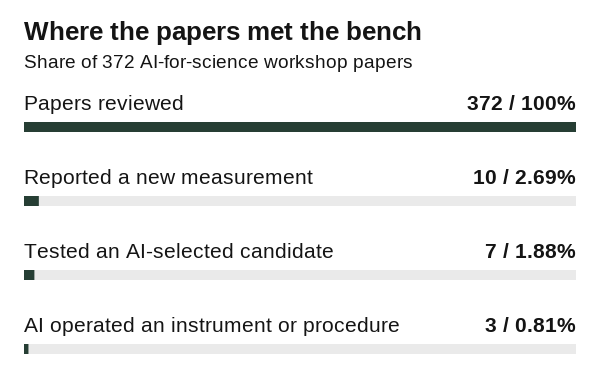
The publication record gives that worry a scale. We reviewed 372 AI-for-science workshop papers at ICML, NeurIPS and ICLR. Ten reported a new physical experiment or measurement. Seven tested an AI-selected candidate or condition in the physical world. Three involved AI in operating an instrument or carrying out a measurement. Each count uses the same 372 papers as its denominator.

Barriers to using AI in research. Share of respondents citing each concern. Korean Academy of Science and Technology, May 2026.
Physical evidence in the workshop sample. Counts describe three separate questions asked of the same papers.

The experiment changes while you are running it

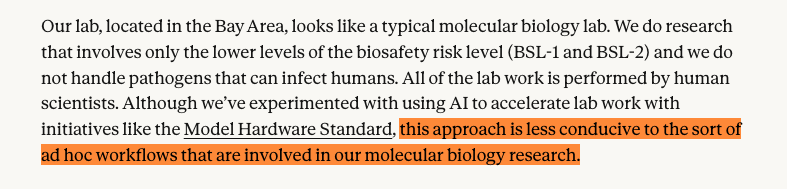
Anthropic described the difficulty from inside its biology lab. A procedure may be written down before a run, yet the next step often depends on what the scientist sees halfway through it. NEA approached the same question from the other end. A system that scores a prediction already assumes somebody has built the apparatus that can tell whether the prediction was right.

Anthropic on the improvised workflows in its molecular biology lab, September 2026.
NEA on the apparatus behind a verifiable reward, June 2026.

What did the proof checker actually check?

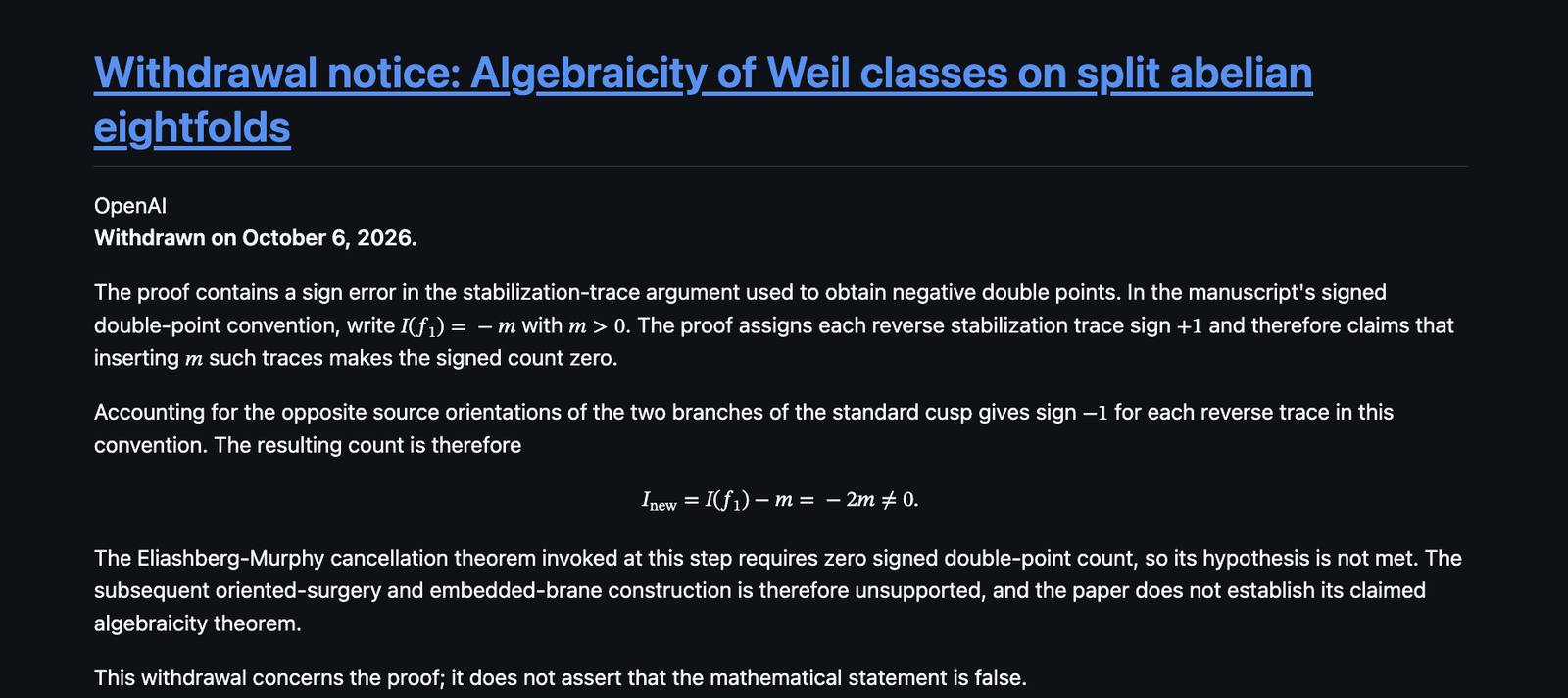
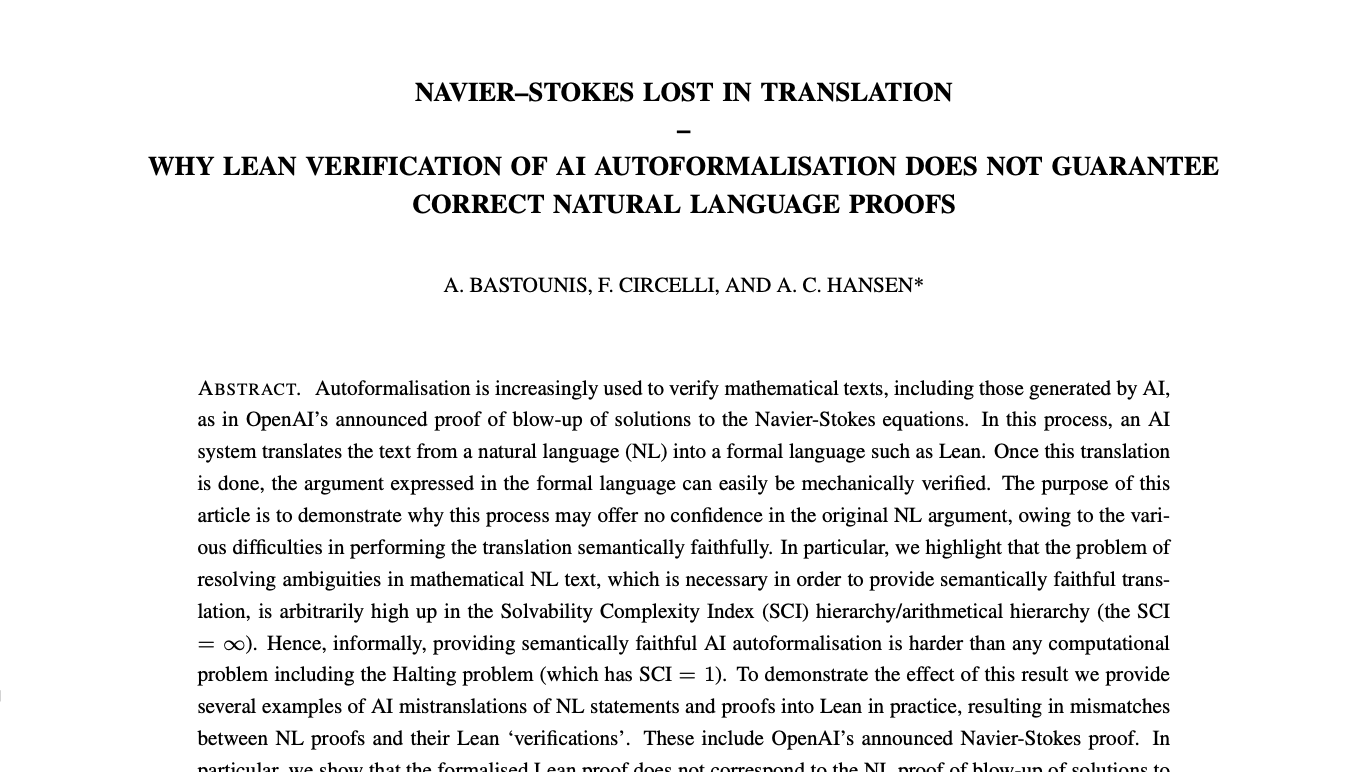
OpenAI released 722 mathematics preprints in October 2026. The subsequent withdrawal of a paper on Weil classes gives one answer to what it costs to check a claim after publication. A separate analysis of a Navier–Stokes argument raises a subtler question. A proof assistant can check every step of a formal argument while the translation from the original problem to that argument still needs a mathematician.

The withdrawal notice for Algebraicity of Weil classes on split abelian eightfolds.
A study of the gap between the Lean formalisation and the natural-language proof.

A field where a candidate answer can meet a checker

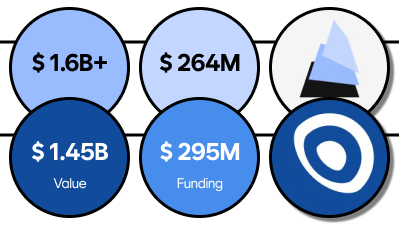
Axiom Math pairs its Lean 4 theorem prover with AXLE, its verification infrastructure. Harmonic's Aristotle also returns proofs that can be checked in Lean. Investors put $264 million into Axiom Math and $295 million into Harmonic. Both companies built around a result another mathematician can check. A physicist holding a new sample has no equivalent certificate.

Valuation and funding, left to right. Axiom Math (top), $1.6B+ and $264M. Harmonic AI (bottom), $1.45B and $295M. November 2026 snapshot.

The queue on the other side of a prediction

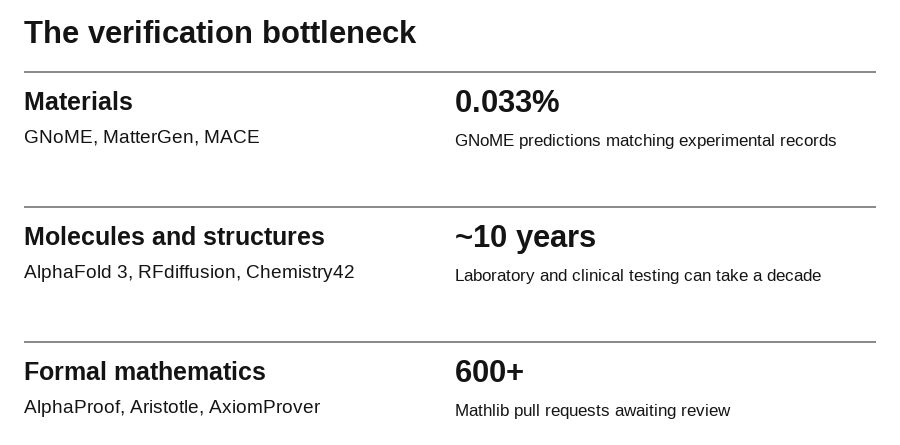
Of roughly 2.2 million structures predicted by GNoME, 736 matched structures recorded independently in the experimental literature, about 0.033%. That fraction counts known matches. The remaining predictions include structures nobody has tried to make. In drug discovery the test can take a decade of laboratory and clinical work. In mathematics the queue is visible in public, down to the hundreds of pull requests awaiting review in Mathlib.

Three kinds of candidate and the work a second party must do to establish what each one means. Figures as recorded in November 2026.

A calculation can finish with the wrong physics

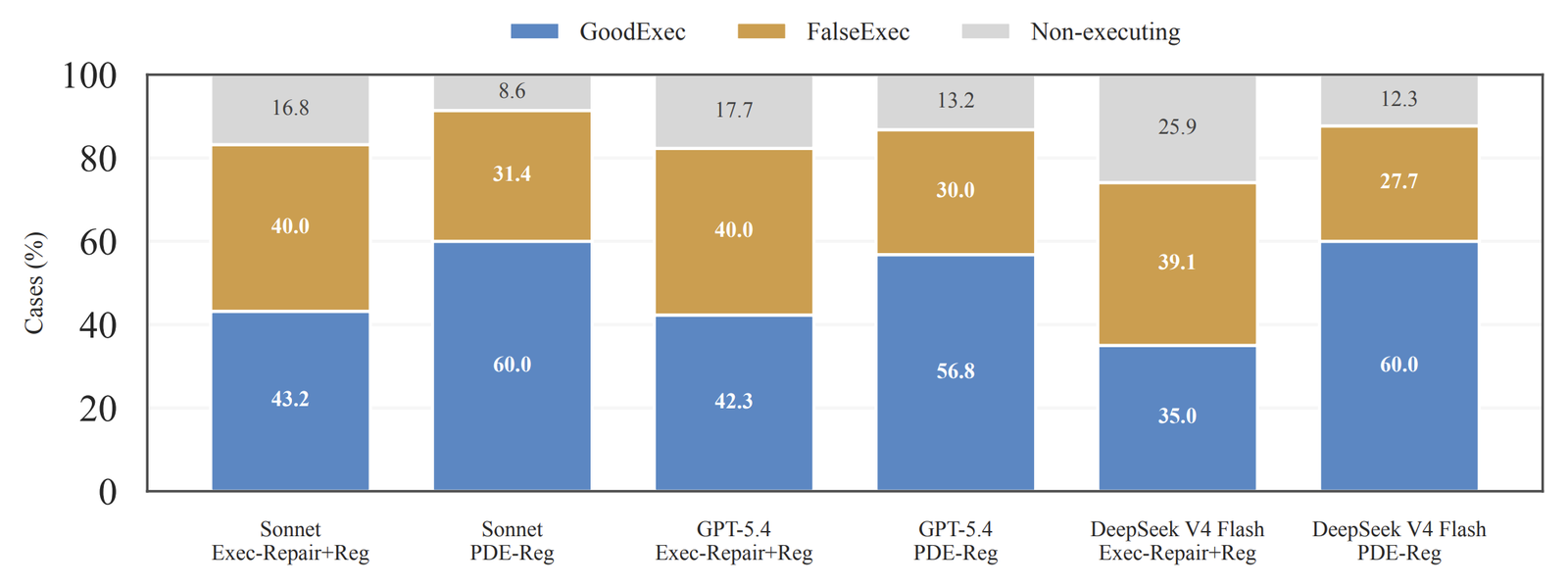
A solver can return an output file even when its input describes the wrong physical problem. In a study of 220 simulation cases per model, fixing execution errors still left 39–40% of all cases running successfully with physics that missed the intended problem. A green exit code is a poor reason to reserve a microscope.

Execution outcomes after repair or equation-based regularisation. The middle band counts cases that ran with the wrong physics.

A shared question in spin dynamics

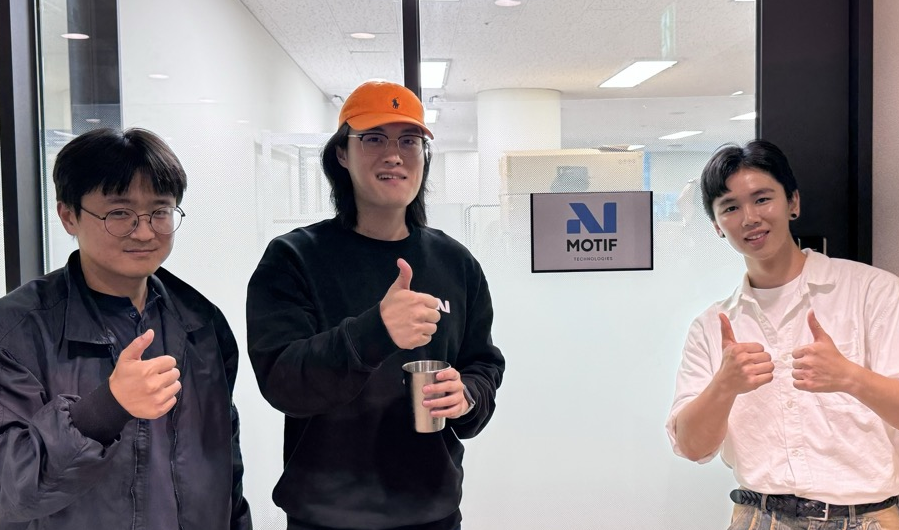
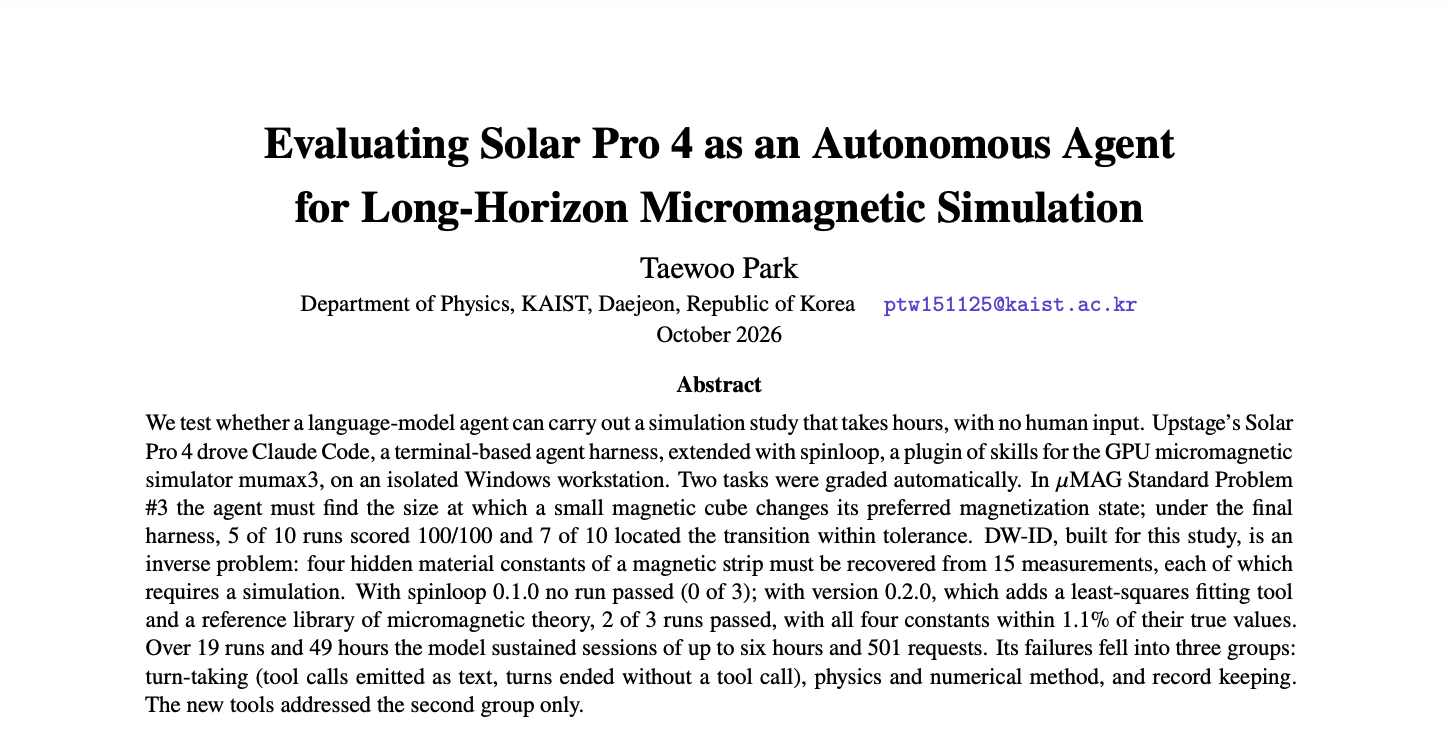
Motif Technologies and Upstage support my spintronics research with model credits. At Motif's invitation I presented my work on the µMAG standard problems to the team at its headquarters. With Upstage's Solar Pro 4, I studied what happens when a simulation lasts for hours and the model has to decide what measurement to request next. We continue to discuss what these results mean for simulation and experiment.

Visiting the team at Motif Technologies.
My October 2026 report on Solar Pro 4 and long-horizon micromagnetic simulation.