Taewoo Park

Startup

OPTIMETA — the first venture

From my September 2026 notes. OPTIMETA, which I co-founded in March 2026, works the formation layer of the stack — the place where a student's own learning record stops living on somebody else's server and starts living on their disk.

A company whose whole thesis fits inside one sentence about ownership

We founded OPTIMETA in March 2026 as a two-person team and it is still pre-launch. My half of the work is front-end development, algorithm design, external engagement and marketing, which is why the surfaces you can actually look at here are a React decision map, a terminal plugin and a stack of README arguments rather than an infrastructure diagram. The six repositories under the organisation's account are the part of the work that has shipped.

The name is a compound. Optimization plus Meta — not optimising a study session, but optimising the choice of what to study at all. Effort, optimised one level up. Every product we have released so far is a different way of making that one choice cheaper: PAIDEIA by reading what the professor assigned, Exam Radar by hearing what the professor stressed out loud.
Study software keeps your learning history and rents it back to you

The standard shape of a study product is easy to describe. Your notes, your cards, your quiz history and your mistakes sit in the vendor's database; the interface over them is read-only; last semester travels with you only if you pay for the tier with an export button. I wrote it without softening in the release essay for our first product: most study SaaS keeps your notes on their servers and charges you monthly for access to your own learning history, and if the company shuts down or raises its price, your study trail goes with it.

So we invert the storage rather than the interface. The course index, the solution patterns, the error log, the weakness reports and the cheatsheet are plain markdown in a folder you already own. The agent is a runner. Cancel the subscription and the study graph is still there — readable, editable, diffable. The formulation I keep returning to is that the learning record does not go inside the product; the product wraps around the learning record.

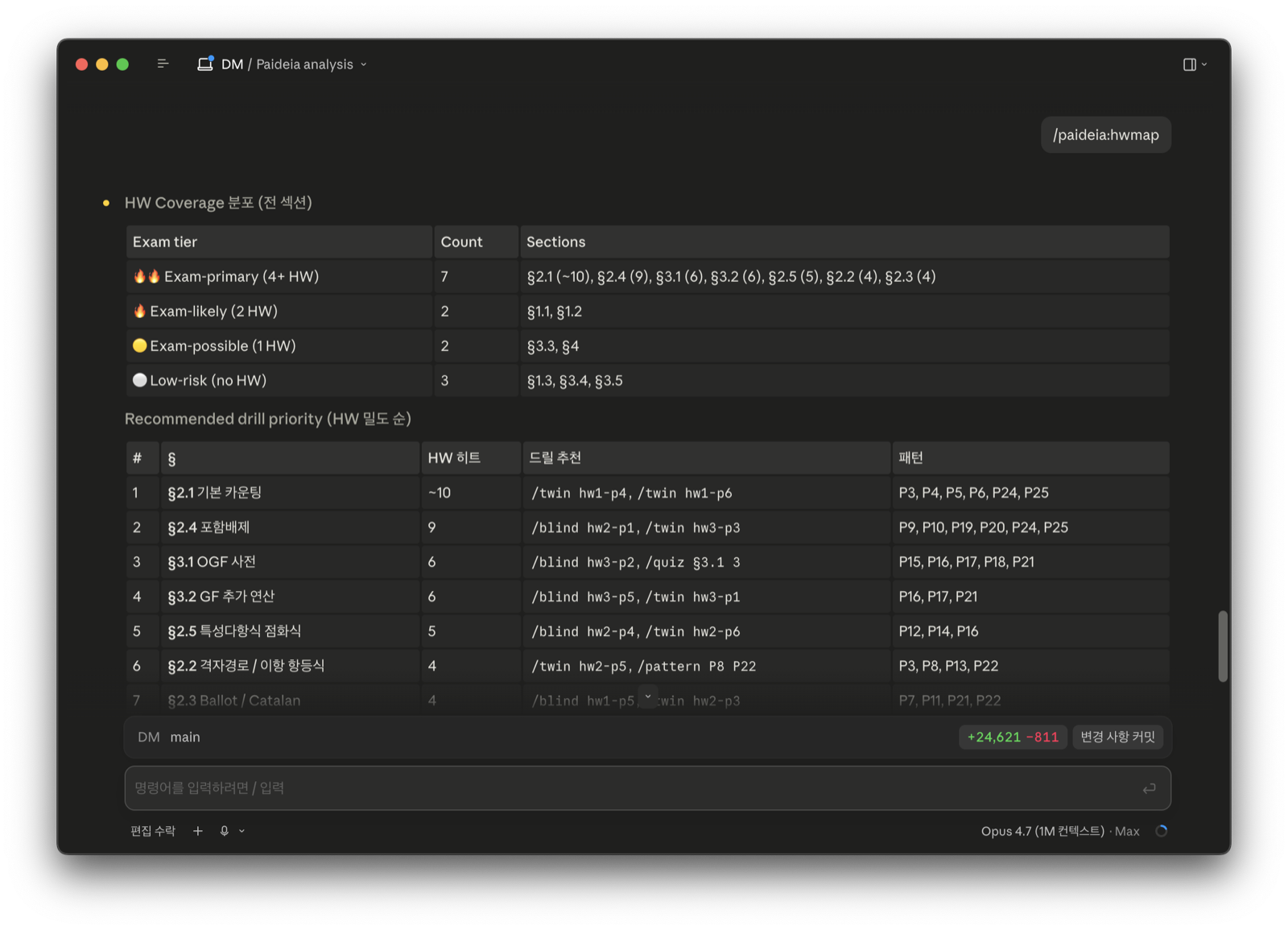
`/paideia:hwmap` — the whole course ranked by homework hits, written as markdown into the student's own folder
/paideia:hwmap — the whole course ranked by homework hits, written as markdown into the student's own folder

The moat has to be one person deep

Our founding argument is competitive, and I open it by conceding the obvious. A company that only wires itself to somebody else's foundation model holds no durable advantage. The two classic answers for a small team — find a narrow domain nobody else has data for, or win on price — both stopped working once the general models became good enough to absorb the niche and cheap enough to erase the discount.

What survives, on my reading, is not model quality but the depth of personalisation. The same prompt returns roughly the same answer to everyone. A dominant lecturer can hold the whole market and still lose to the neighbourhood tutor who has sat with one student for ten years and can tell at a glance what they are about to get wrong. The moat is the dense daily context of one person's life: what they do not know, which error they keep repeating, what their own materials look like. That is not a thing a frontier lab can reach from the outside, and it is not a thing you can buy — it accumulates, a week at a time, in a folder.

Below the waterline we call what we are building a Personal Study Operating System, a wholly new layer of architecture rather than a smooth wrapper around an LLM. That product is not named on this page. The released pieces are.

Cold start is the problem the second product exists to solve

Full personalisation cannot sit on a general curriculum. It has to run on data the user produces — their lectures, their teacher, their wrong answers. That premise carries an immediate cost: on day one there is no such data, and a service that only becomes useful in week six will not survive week one.

PAIDEIA answers half of it by reading material the student already has on their machine. Exam Radar answers the other half by catching the lecture as it happens. Alt, the note application that records and transcribes lectures, opened a plugin surface — news we got from Alt's chief executive, 이정연 Coby — and we started work the same day. Attend the lecture, and personal context begins accumulating before a single homework set has been graded.

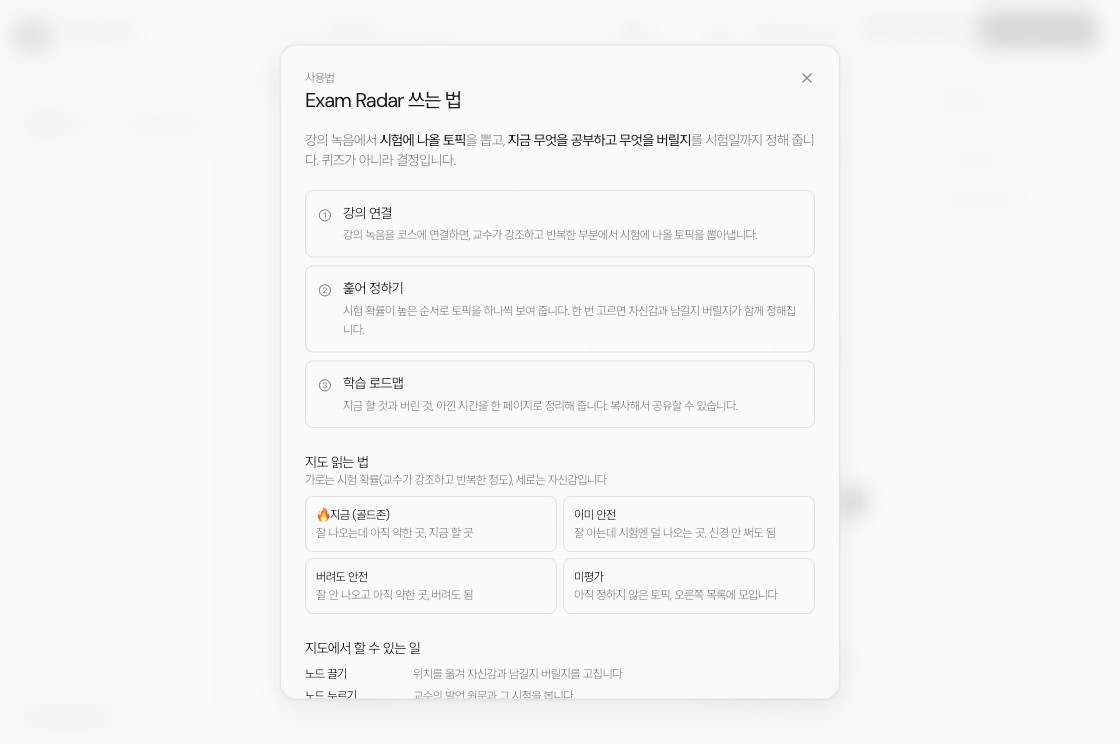
Exam Radar's in-app guide — three steps, how to read the two axes, what each quadrant means

The shipped MVP turns one course folder into a permanent study graph

PAIDEIA runs a single course from ingest to cheatsheet. PDFs of lecture notes, textbook chapters, homework and solutions go in; a topic tree, a set of recurring solution patterns labelled P1 through Pk, a homework-to-section coverage map, an append-only error log and a one-page error-driven cheatsheet come out — all markdown, all in the folder. It reached number one on GeekNews' realtime ranking and a Weekly pick, and carries 91 stars.

Its load-bearing claim is deliberately contrarian, and I argue it properly on its own page: homework density equals exam probability. Hunting your blind spots is backwards advice, because the professor has already announced the exam in the shape of what they chose to assign.

The second product sells subtraction

Exam Radar reads a lecture transcript, ranks topics by how hard the professor leaned on them, takes one tap of confidence per topic from the student, and plots the two against each other. Where high exam probability meets low confidence is the gold zone — start here. The opposite corner is labelled safe to drop, and printing that label is the point of the product.

Its promise, study less and score higher, is also its defence: a tool whose first useful sentence is that you can skip section 4.2 is one a quiz generator cannot copy without arguing against the thing it sells.

Five runners exist because the runner is the replaceable part

The same study engine ships for Claude Code, OpenAI Codex, opencode and Hermes Agent, and for Alt as a local MCP server that lets Alt's own model write into the folder directly. That is not platform ambition. It is my ownership claim being put under test: if the folder on disk really is the product, then swapping the agent that writes into it should change nothing at all.

A single plugin that writes markdown is a claim about file formats. Five independent runners writing into one folder layout is the part of the claim somebody else can check, and what came back is the answer I wanted.

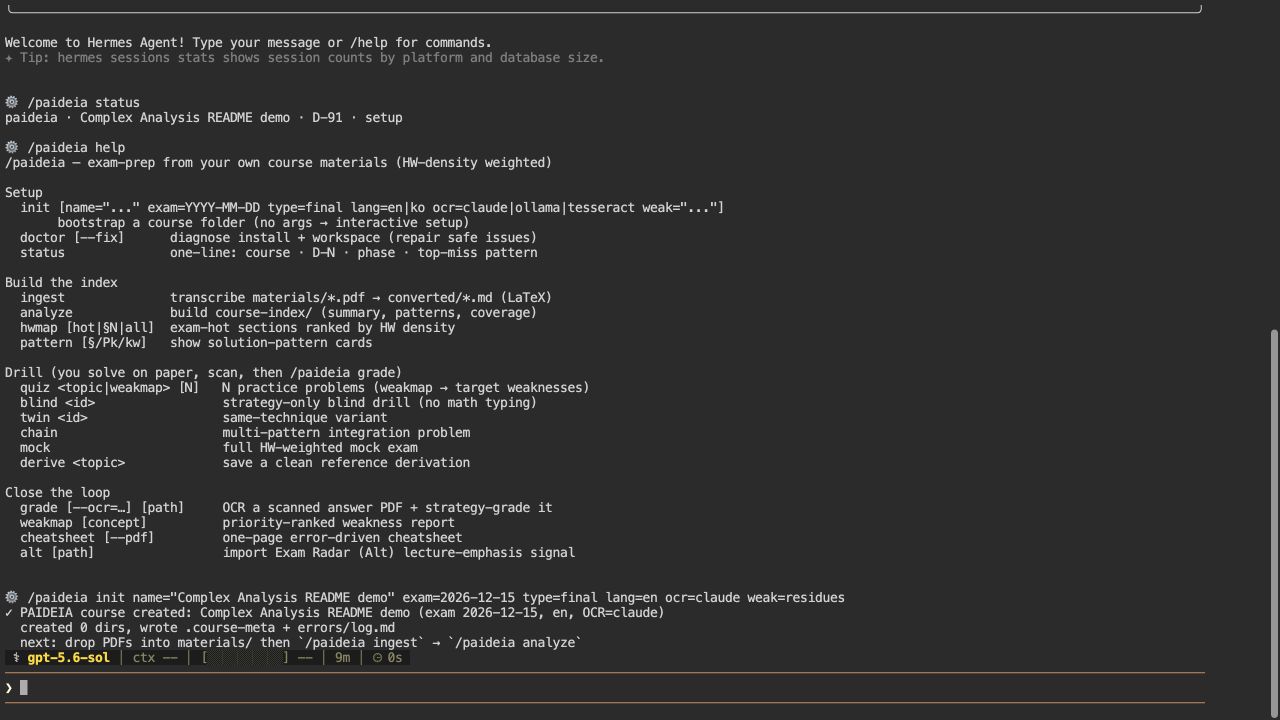
The Hermes edition's whole command surface, reached from a chat room — the same seventeen actions, the same folder

What is public, and what is not yet

The organisation, the shipped MVP and the companion plugin are public, along with four ports and an MCP server, and every one of them is MIT-licensed and readable end to end. What the two of us have been preparing since March is not public, and I am deliberately leaving it unnamed here.

What the released repositories do show is the position we will launch from. The study record belongs on the student's own disk; the personalisation worth paying for is only possible once it lives there; and the company that can build it is the one close enough to a single person's week to know what they are about to get wrong.

Why we stopped at the first version

The first version was also the last. We had built a study record that a student could keep, move and inspect. In conversations with customers, I kept coming back to the same question: what did all that engineering change when they sat down to study? The improvement they experienced was much smaller than the improvement we could demonstrate.

As the operator of Trendchaser, I watched capabilities that once sustained whole SaaS products become features of general-purpose models. Building OPTIMETA taught me what that collapse felt like on the customer’s side of the screen. We decided to take on a longer problem, one that would survive the next leap in model capability. That decision took us back to my lab, and to PhEVRA.